



Insights
From Security Copilots to Agentic SOCs: What Is Changing?
16 September, 2026


Generative AI has already changed how security teams interact with security data. Copilots can summarize alerts, explain unfamiliar activity, generate queries, and recommend next steps.
However, helping analysts understand the work is not the same as completing it. This gap is driving the next stage of AI in security operations: the shift from AI-assisted analysis toward AI-driven workflows.
What Did Security Copilots Solve?
Security teams work across endpoints, identities, networks, cloud environments, applications, and multiple security platforms. Each system has its own interface, data model, and query language. Security copilots introduced a natural-language layer between analysts and these systems. They can help teams:
- Summarize alerts and incidents
- Explain technical findings
- Generate or refine queries
- Retrieve relevant information
- Recommend investigation and response steps
- Turn fragmented telemetry into readable narratives
These capabilities make security information easier to understand and reduce some of the repetitive work involved in searching, querying, and documenting incidents.mHowever, most copilots remain fundamentally assistive. An analyst asks a question, receives an answer, decides what to do next, and provides another instruction.
Copilots improved how people interact with security systems. They did not fully solve how security work gets completed.
Why Is the Copilot Model No Longer Enough?
A copilot may tell an analyst what happened and recommend the next step. But the analyst is often still responsible for connecting the entire investigation.
This may involve opening multiple tools, gathering evidence, correlating users and assets, selecting the next investigative path, executing response actions, monitoring the result, and documenting the case. In other words, AI assists with individual steps while the human still has to assemble those steps into a complete workflow.
Traditional automation can execute predefined rules and playbooks efficiently, but security investigations do not always follow a predictable path. New evidence may change the initial assessment, require information from another system, or call for a different response.
A static playbook follows the path created in advance. A copilot recommends what the path could be. Neither necessarily owns the task from investigation through resolution.
This is the operational gap that Agentic SOCs are intended to address.
What Is an Agentic SOC and How Is It Different?
An Agentic SOC applies agentic AI to security operations so that AI can pursue a defined security objective across multiple steps, tools, and decisions.
Instead of waiting for an analyst to prompt every action, the system can receive an objective, such as investigating a suspicious login or validating an endpoint alert, and determine how to move the task forward.
Its operating cycle can be understood as:
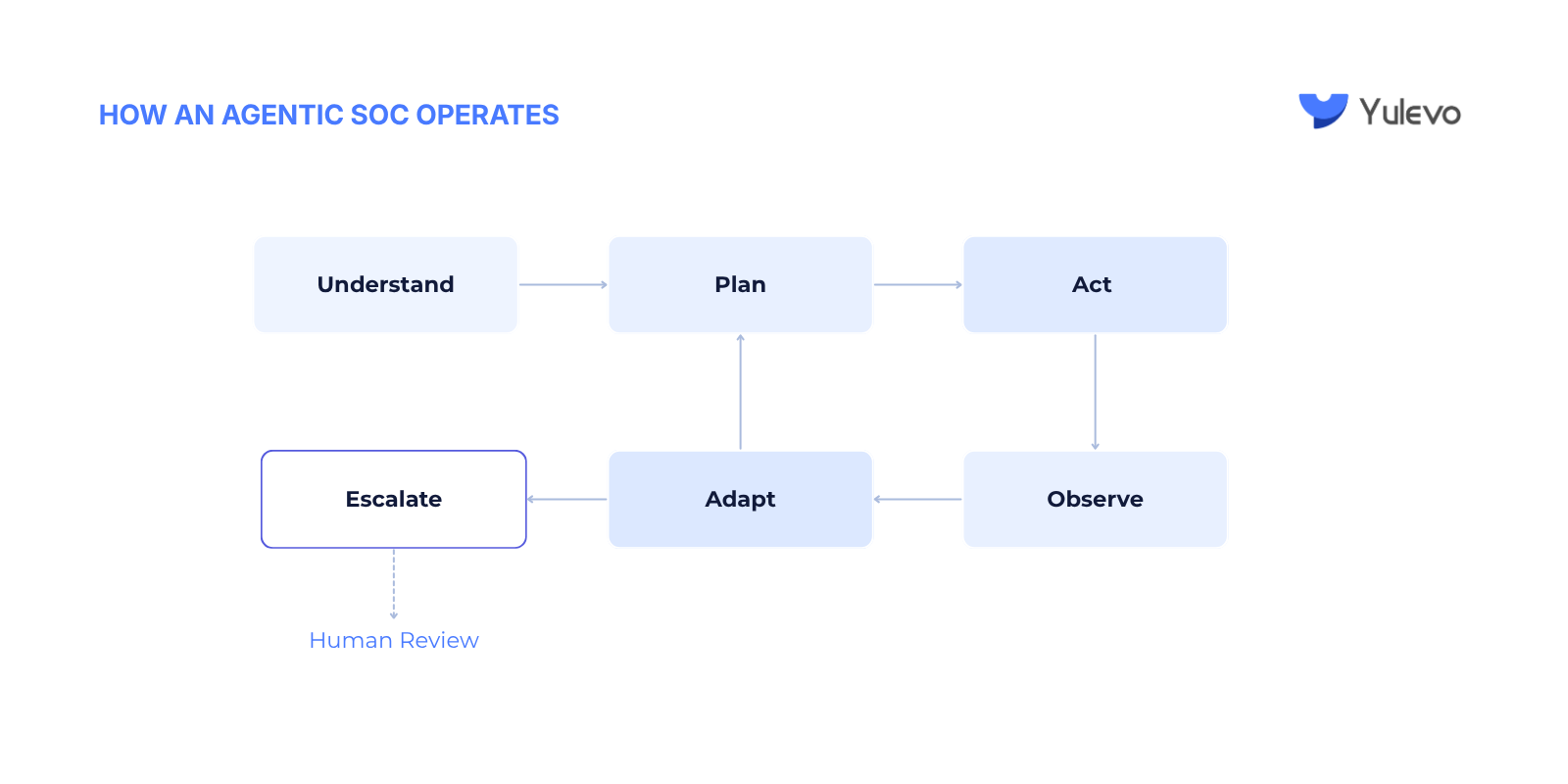
The system gathers relevant context, plans an investigation, uses connected tools, evaluates the results, and adjusts its approach as new evidence emerges. When confidence is insufficient or an action exceeds its authority, it escalates the case to a human analyst.
The essential difference is therefore not the quality of the chatbot interface:
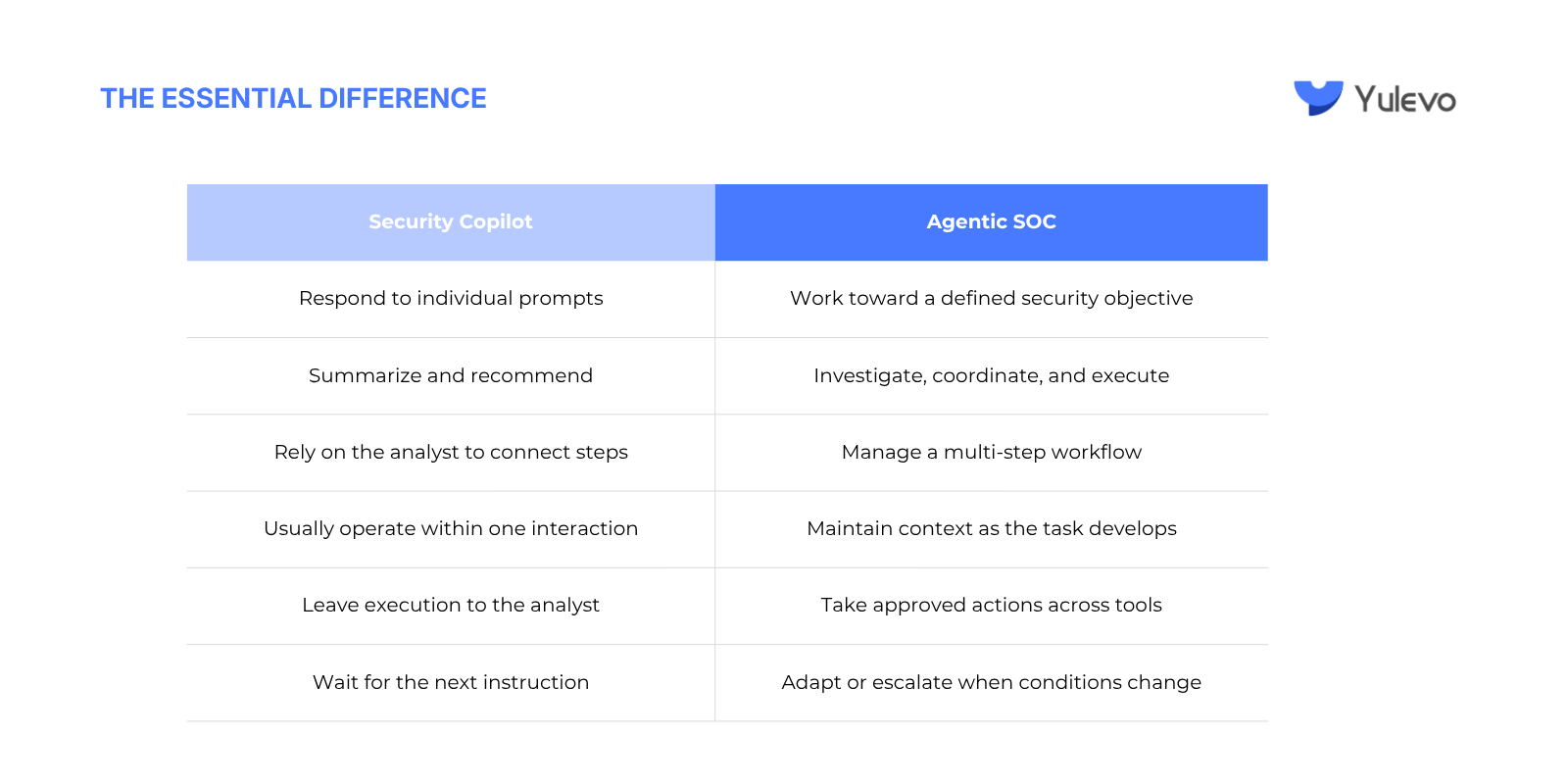
As interest in agentic AI has grown, the term has also been applied to products that remain conventional assistants, chatbots, or automation systems.
Gartner calls this practice agent washing: rebranding existing technologies without adding meaningful agentic capabilities.
“Many vendors are contributing to the hype by engaging in ‘agent washing.’”
Adding a conversational interface to a security platform does not automatically make it agentic. Neither does connecting an LLM to a predefined playbook.
The more useful question is whether the system can take a defined objective, determine the required steps, work across relevant tools, adapt when new evidence appears, and escalate decisions that require human judgment.
Agentic Does Not Mean Uncontrolled
An Agentic SOC should not give AI unlimited authority over the security environment.
Different actions carry different levels of risk. Gathering evidence or enriching an alert may be suitable for autonomous execution. Isolating a production server or disabling a privileged account may still require human approval. A governed Agentic SOC should therefore define:
- Which systems the AI can access
- Which actions it can perform autonomously
- Which decisions require human approval
- Which actions are prohibited
- How decisions and actions are recorded
- When a case must be escalated
Gartner predicts that more than 40% of agentic AI projects will be canceled by the end of 2027 because of escalating costs, unclear business value, or inadequate risk controls.
At the same time, it predicts that 33% of enterprise software applications will include agentic AI by 2028.
Together, these predictions suggest that agentic AI will become more widely adopted, but successful deployment will depend on clear objectives, measurable value, appropriate system access, and strong governance.
The goal is not autonomy for its own sake. It is controlled delegation: allowing AI to complete appropriate security tasks while keeping consequential decisions explainable, auditable, and under human oversight.
From Assistance to Execution
Security copilots made security information easier to access and understand. Agentic SOCs aim to make security work easier to complete.
The shift is not simply from one interface to another. It is a change in the operating model:
Copilots help analysts perform the work.
Agentic SOCs take responsibility for defined parts of the work.
This does not mean that every security process should become autonomous or that human analysts will disappear. Different organizations and use cases will require different levels of authority and oversight. The immediate opportunity is to identify well-defined security tasks where AI can combine context, reasoning, tool use, and governed execution to produce a measurable outcome.
At Yulevo, we see this shift as a move from AI-assisted analysis toward AI-driven security workflows, where AI can understand context, plan investigations, coordinate security capabilities, and complete defined tasks within governed boundaries.
In a follow-up article, we will take a closer look at the architecture behind this approach and the capabilities required to put agentic security operations into practice.
- Start your 30-day free Senvo trial today!
- All your tools in one place
- Save time and boost efficiency
- Use 30 days for FREE
You May Also Like
-

- Events
- Highlights from the 2026 China Cybersecurity Week Hong Kong Sub-forum
- 28 September, 2026
- On 17 September, Yulevo participated in the 2026 China Cybersecurity Week Hong Kong Sub-forum. The event brought together representatives from government, industry and academia to explore how Hong Kong can strengthen cyber resilience while accelerating digital innovation and AI adoption.
-

- Events
- Yulevo at Bitcoin Asia 2026: Bringing Security to Web3 Community
- 31 August, 2026
- Over two days at Booth #19, our team connected with professionals from across the Bitcoin and broader Web3 ecosystem, exchanging perspectives on emerging security risks, infrastructure protection, vulnerability management, and the challenges security teams are encountering in real-world environments.
-

- Customer Stories
- How to Build a Scalable Security Foundation for a Leading Automotive Digital Platform
- 21 August, 2026
- Entering new markets brought new workloads and security requirements. As the company's global footprint expanded, so did its attack surface.